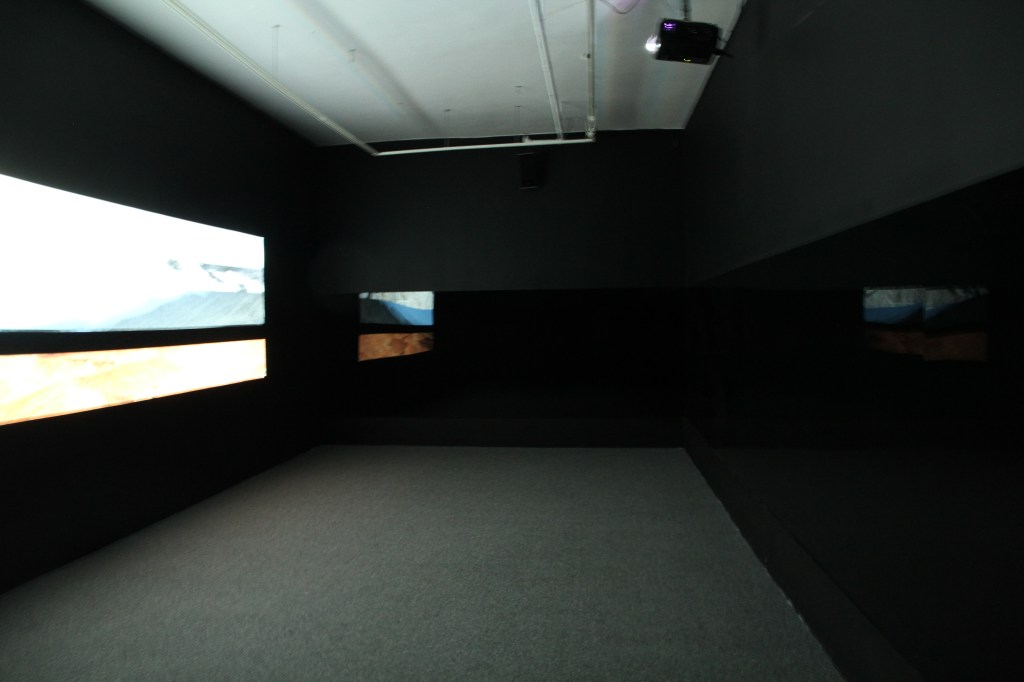

Ei, A/V installation, 2011
Paysages naturels et urbains déconstruits s’y déploient sur fonds musicaux «électro-organiques», trames sonores qui miroitent auditivement l’architecture des images en mouvement et qui, inversement, y laissent des traces visibles graphiquement. «ei», nouvelle œuvre inspirée de tableaux peints par Edward Ruscha, est sa proposition la plus épurée à ce jour. L’artiste poursuit son exploration des notions du double, de l’abandon et de la disparition dans cet environnement immersif qui sonde l’espace mythique des déserts américains.
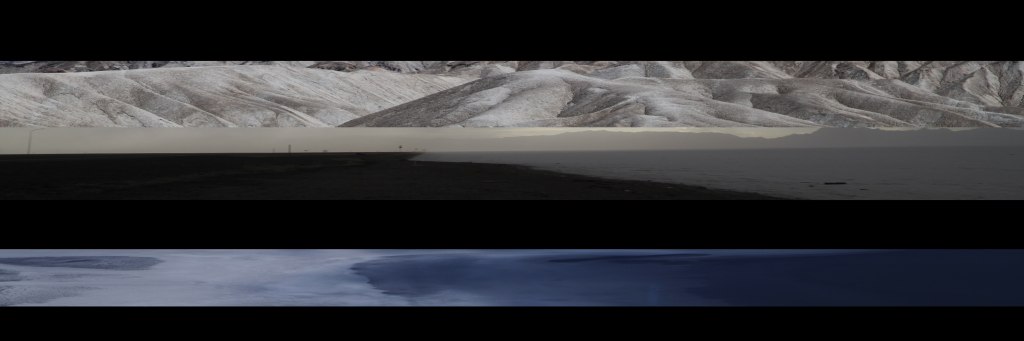
De longs panoramiques y investissent progressivement toute la surface de l’écran. Ils défilent en bandes horizontales mouvantes, une composition en strates renvoyant tant à l’ordre géologique (couches de sédiments) qu’à un formalisme bien assumé. Au-delà de ces rappels, le morcellement de la surface, le dédoublement de prises de vue et le prolongement d’actions au sein même de certaines images accentuent l’impossibilité de saisir les motifs d’origine dans leur globalité. Ce sont quelques parcelles conservées en mémoire qui permettront de révéler les translations opérées par l’artiste; malgré l’impression d’unité spatiale et temporelle qui peut se dégager de l’ensemble, l’on y retrace ainsi de multiples paysages. Cela dit, les scènes captées sont agencées et recadrées sans autres interventions, (ré)activant divers accidents naturels en guise de liants : le tracé sinueux des routes et de la crête des montagnes, la végétation éparse émergeant des différentes tonalités de sable… L’artiste n’en altère ni le dépouillement, ni le lyrisme intrinsèque, s’en remettant à ce qu’elles lui inspirent intuitivement – l’immensité, le vide, le silence – une expérience et une attente qu’elle cherche à retranscrire en musique.
La bande sonore enveloppante qui en résulte plonge le visiteur dans un univers d’autant plus ambigu, une ambiance déroutante qui infuse une tension narrative aux vidéos. Notes, murmures et grésillements évoquent à la fois foulées humaines, pullulement d’insectes ou vrombissements atmosphériques. Enfin, la mise en espace de l’installation permet d’approfondir davantage les questionnements de Rajotte sur l’interaction œuvre/spectateur : les projections se situant dans un espace restreint, ce dernier est contraint de se mouvoir, un déplacement dans l’œuvre qui, selon l’artiste, «s’intègre dans une trame temporelle, tel un plan-séquence».
– Geneviève Bédard
L’artiste remercie le Conseil des arts du Canada et Perte de signal.
«ei» fait l’objet d’entrevues radiophoniques à l’émission In situ sur les ondes de CIBL et Espace Visuel, CINQ FM 102,3.
Entrevue de Nelly-Ève Rajotte à l’émission In Situ (In situ, 2 février 2011)
Entrevue de Nelly-Ève Rajotte à l’émission Espace Visuel (Espace Visuel, 10 février 2011)

Ei documentation exposition Optica 2011 from Perte de Signal on Vimeo.
Deconstructed natural and city landscapes unfold on an « electro-organic » musical backdrop. The soundtracks, shimmering reflections mirroring the structure of the moving images, leave their own visual traces. « ei », a new work inspired by the paintings of Edward Ruscha, is her purest expression to date, as she continues her investigations of the concepts of the double, of abandonment, and of disappearance in an immersive environment that sounds out the mythical spaces of the American desert.
Long panoramic shots gradually invest the entire screen area. They stream by in horizontal bands, a layered composition suggesting geological strata (sedimentation) as much as a well-asserted formalism. Beyond these references, the fragmented surface, the proliferation of points of view, and the extension of actions into some of the images themselves all accentuate the impossibility of fully grasping the original motifs. A few fragments preserved in memory reveal the artist’s translations; despite the sense of spatial and temporal unity suggested by the presentation, one can trace a number of landscapes therein. That said, captured scenes are arranged and reframed without further intervention, (re)activating various natural occurrences as binding elements: the winding tracks of roads and mountain ridges, sparse vegetation emerging from multi-tonal drifts of sand… The artist preserves their spareness and intrinsic poetry, focusing on the intuitively inspiring—immensity, emptiness, silence—, an experience and expectation she strives to transcribe into music.
The enveloping soundscape plunges visitors into an uncertain universe, a troubling atmosphere that injects the video images with narrative tension. Notes, sussurations, and cracklings suggest buzzing insects, footfalls, atmospheric rumblings. Finally, the installational setup allows Rajotte to pursue her interrogation of the interactions between spectator and art work: projections are located in a constrained space, forcing visitors to move. According to the artist, this movement within the work becomes a part of the temporal plotline, much like a shot sequence.
– Geneviève Bédard
 Nelly-Eve Rajotte
Vous devez être connecté pour poster un commentaire.