Trees communicate with each other at 220 hertz, December 5, 2025—April 19, 2026
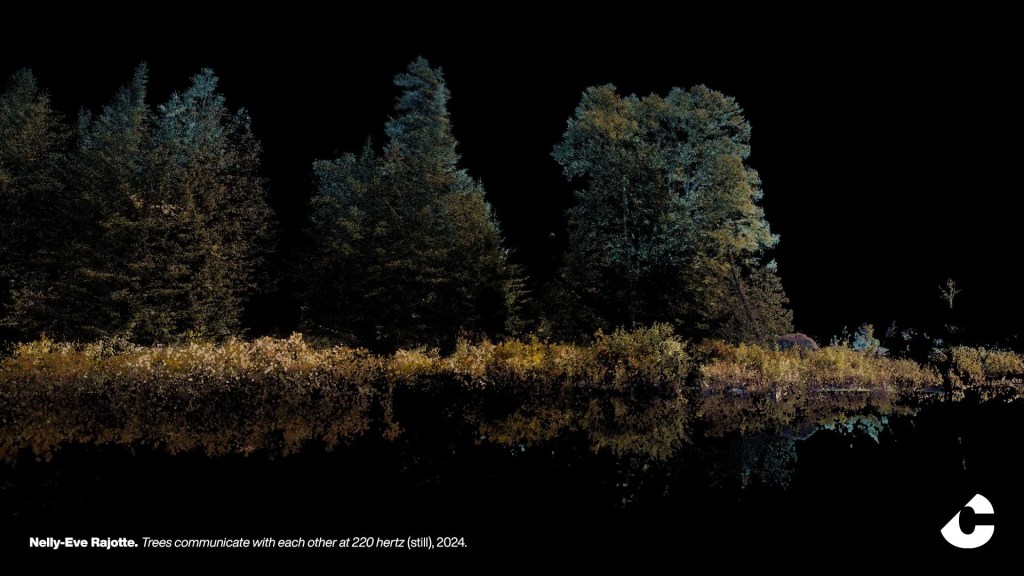
In her first Calgary exhibition, Montreal-based artist Nelly-Eve Rajotte presents the large-scale multi-media installation, Trees communicate with each other at 220 hertz (2024). Combining moving image, generative sound, and technological devices that listen through a modular synthesizer connected to a live tree, this immersive, sensory work brings nature, technology and the romantic imagination in dialogue to consider the deeper connections within our ecosystem.
Forests are the lungs of the earth. Trees are sanctuaries, they are our relatives, our teachers, our allies. Poetic or trite statements about the beauty and importance of forests abound, yet human attitudes toward their preservation and care remain fickle. Dark fantasies about the mysteries to be discovered deep in the woods, adventures that provide formative experiences and steel a hero’s resolve, the solace to be found in the trees’ majestic fold, all populate our collective imaginary since childhood, obscuring humbler truths and setting humanity apart from nature.
Exploring both emotional and physical terrains, Rajotte’s installation draws audiences into a space of profound contemplation and communion. While the panoramic vista she creates, inspired by the boreal forest, evokes the sublime landscape tradition of painters like Caspar David Friedrich and J.M.W. Turner, here the viewer is not confronted but embraced. Inviting an intimate encounter between the self and the vastness of the external world, the work opens a path to receptivity and empathy.
Oscillating in and out of visibility, Rajotte’s spectral cinematic space requires the viewer to actively participate, moving between observation and immersion. Through LiDAR scanning, she digitally archives endangered sites, building a three-dimensional memory that considers non-human modes of capturing the landscape. Addressing climate change and the disappearance of species, the work urges reflection on the fragility of the living world and on new forms of technological memory. A trail of breadcrumbs leads us to the understanding that the forest was always home.
Curated by Mona Filip.
Nelly-Eve Rajotte. The trees talk to each other at 220 Hertz, 2024. 3-channel video installation, 4K, colour, generative sound, 25 min, modular synthesizer, electrodes, and tree.
Credits:
VFX artist / Software developer: Codrin-Mihail Tablan Negrei
3D laser expertise – iSCAN 3D: Richard Lapointe
 Nelly-Eve Rajotte
Vous devez être connecté pour poster un commentaire.